
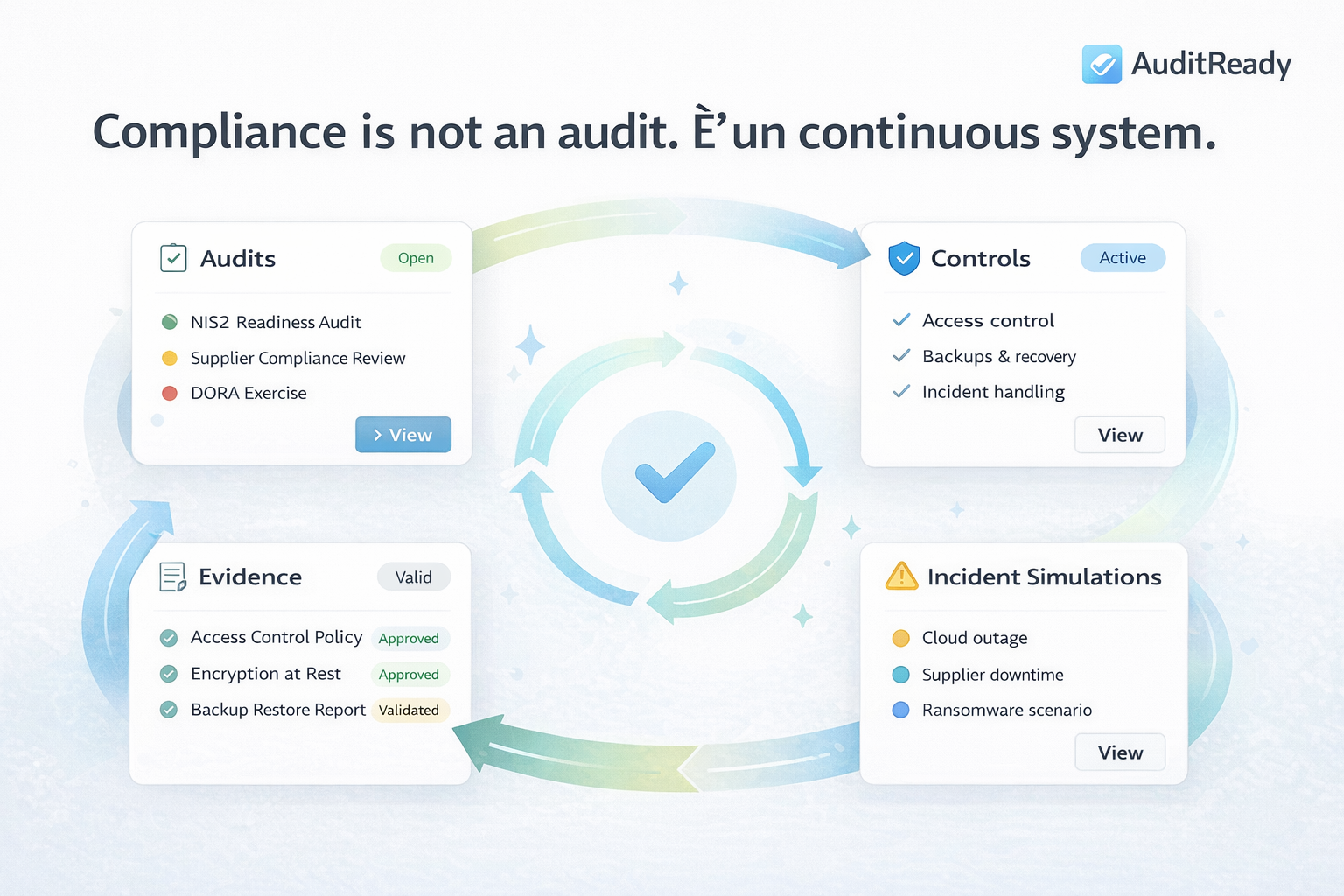
In recent years, the word compliance has become unavoidable. New regulations, new frameworks, new obligations. Yet many organizations still approach compliance in the same old way: prepare for the audit, pass it, and then move on.
This approach no longer works.
Compliance is not an event. It is not a checklist. And it is not a collection of documents produced under pressure.
Compliance is a continuous system.
The limits of an audit-driven approach
Many organizations still operate like this:
- documents gathered right before the audit
- files scattered across emails and folders
- unclear ownership
- evidence prepared “for the auditor”, not for real control
This model only works when:
- the environment is stable
- dependencies are limited
- incidents are rare
NIS2, DORA and new European regulations assume the opposite: instability is the norm.
From declared compliance to demonstrable control
Authorities are no longer asking:
“Do you have a policy?”
They are asking:
- who is responsible
- what is actually under control
- which evidence proves it
- what happens when things go wrong
This means compliance must:
- exist over time
- stay up to date
- be connected to real systems
- produce verifiable evidence
In other words, it must become part of how the organization operates.
Evidence-first compliance
A modern compliance system starts from a simple principle:
statements are not enough — evidence matters.
Policies, controls, audits and simulations are not separate outputs. They are connected elements of the same system.
When compliance is evidence-first:
- every control has an owner
- every piece of evidence has a status
- every decision is traceable
- every audit becomes a snapshot, not a last-minute rush
Audit-ready, every day
Being audit-ready does not mean “ready when needed”. It means not having to change behavior when the audit arrives.
A continuous compliance system allows organizations to:
- reduce operational risk
- improve incident response
- face audits and inspections with confidence
- demonstrate organizational maturity
AuditReady is built around this idea: turning compliance from a stressful event into a governable system.